Multiculturalism Shapes Canadian Life. Does it Shape our Architecture?
As the country’s diverse, multi-ethnic population now finds proud expression in arts and culture, the built environment stands at the precipice of a quiet evolution.
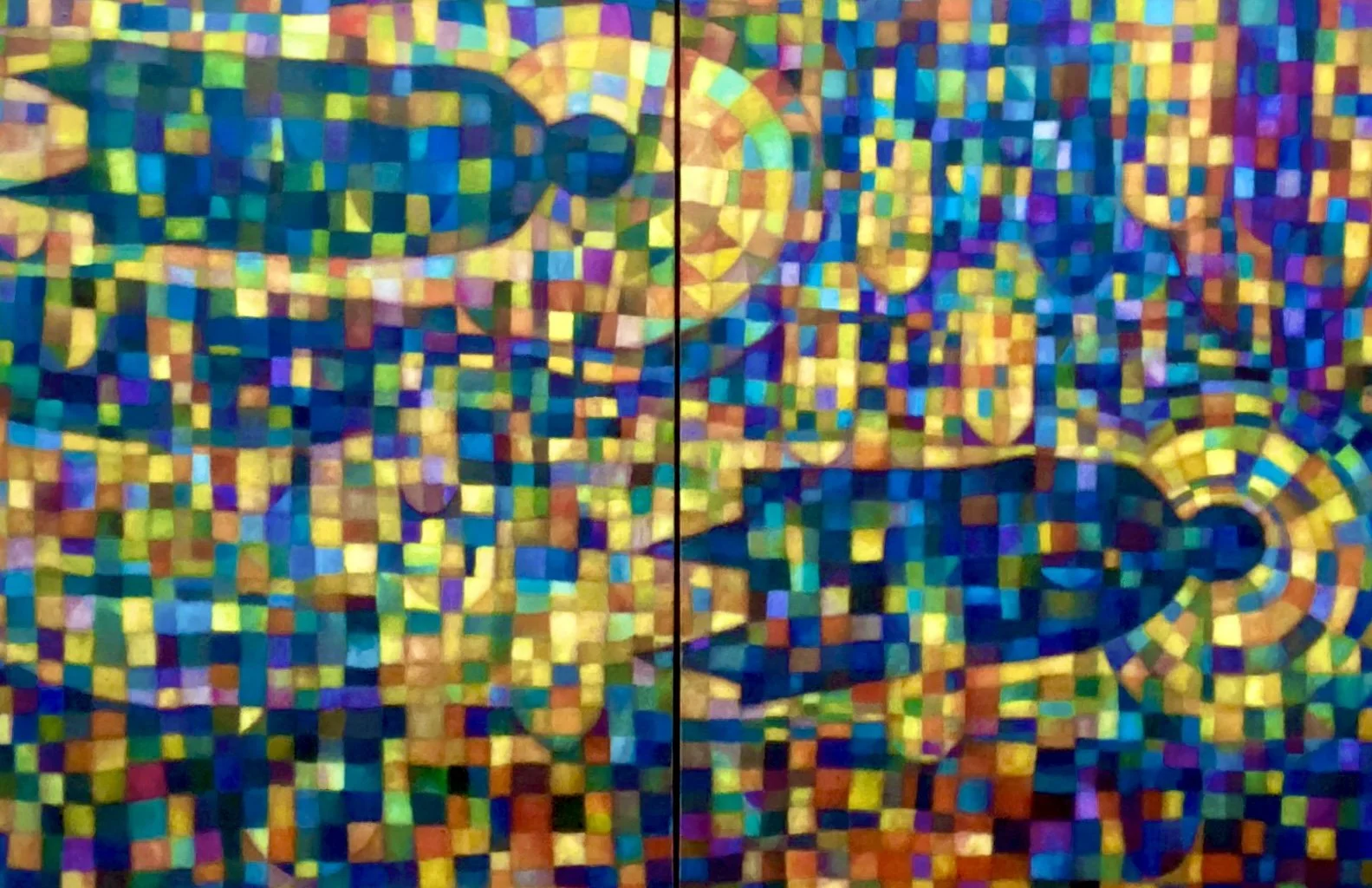
Painting: Heimo Haikala, “Flight of Brothers”, Oil on canvas, 2002
On Tuesday, January 20, Mark Carney earned a standing ovation on the international stage. Speaking at the World Economic Forum in Davos, Canada’s Prime Minister diagnosed a stark geopolitical reality, identifying “a rupture, not a transition” of the global order. In a year marked by tariffs, taunts and takeover threats, Carney rallied against a world where “the strong do what they can, and the weak suffer what they must.” Even for skeptics pointing to chronic gaps between the government’s “elbows up” posture and complaisant foreign policy, the emphatic defence of democratic values and national sovereignty kindled the civic embers of patriotism. “Canada is a pluralistic society that works,” he stressed. “Our public square is loud, diverse, and free.”
Two days later, the Prime Minister gave another speech, this time on home soil. Where last Tuesday’s address championed Canada’s place in the world order to the international media and the Davos Set, his Quebec City remarks were aimed at a more intimate audience of 42 million Canadians. Standing at the Plains of Abraham, where a decisive 1759 battle shaped the Seven Years War between France and England and then the founding of Canada itself, Carney reached across centuries to situate pluralism as the bedrock of national identity. Instead of following a “familiar pattern of conquest,” where “the vanquished [are] absorbed, their language suppressed, their faith proscribed, their laws replaced,” French and English cultures both continued to flourish. In Carney’s telling, those early roots nourished the inclusive multiculturalism that defines the country today.
Although it makes for a somewhat rose-coloured and selective narrative — even with Carney’s acknowledgement that Canada was built “on the dispossession of, and broken treaties with, Indigenous Peoples” — the aspiration hit home. For many of us, multiculturalism is a bedrock of Canadian identity, especially at a time when our closest neighbours raise borders and draw ever starker lines of division. In a country otherwise allergic to grandiose symbolism, it all evoked something close to a national mythos; a quiet secular hymn that we might all live together, learn from one another, and grow stronger through our differences.
While multiculturalism is formally engrained into the federation as both law and public policy, cultural expressions of Canadian diversity live in food, cinema, music, fashion or literature. Consider the 2024 film Universal Language, which imagines a Canada where French and Farsi are dominant languages, and where the Tim Horton’s logo retains its red maple leaf but swaps Latin script for Persian. Winnipeg’s still frozen solid, hockey’s still on TV, but nobody’s speaking English. It’s uncanny, absurdist, yet it all feels remarkably natural. In 2026, a walk through any major city reveals a mosaic of influences, from houses of worship to hair salons. Even Canadian literature, long a stodgy bastion of snowy cabins and rural acreages, has evolved from Michael Ondaatje and Anne Michaels’s early stories of global migration to a younger CanLit generation that reflects the country’s urban, queer and multiethnic textures. In theatre, Ahmed Moneka’s 2019 play In Sundry Languages combines eight different dialects to conjure a symphony of cultures. In the end, everyone ends up understanding one another.
Step out onto the street and find women in saris paired with parkas and Sorrel boots. Or just eat at a restaurant. If you’re in Toronto, just about any global cuisine is found on our menus. And if you’re looking for a mix of cultures, start with Susur Lee, whose rise to stardom as a fusion chef at the turn of the millennium reflected the city’s ascent as a hyper-diverse metropolis. Interpreting Chinese, Thai and Malaysian comfort food through a formal French lens within a laid back North American setting, Lee’s eponymous restaurants became international landmarks of fusion cuisine. At a time when Toronto remained a relative culinary hinterland, the city emerged as an early innovator in a haute global trend. Of course it took off here: Not for nothing, the city’s official motto is “Diversity, Our Strength.”
While Canada’s evolving population now finds manifold expression in arts and culture, the built environment tells a different story. The sidewalk ballet of pedestrians and storefront signage evince an eclectic melange of backgrounds and lifestyles, but what about the brick and mortar fabric behind it all? Where are the buildings and civic spaces emblematic of the same qualities? When you step away from it all and squint, shouldn’t our cities themselves start to look like a mosaic of forms and styles? And wouldn’t a place like Toronto, whose global brand leans so heavily on celebrating diversity, and whose cultural products so vividly reflect it, also yield a Susur Lee of architecture?
Ornament and Culture
The Venice Biennale of Architecture is a Davos for the design set. Like its Swiss counterpart, it is ambitious, occasionally inspiring, structurally elitist and arguably outright misguided. For us architecture critics, however, it’s a rare opportunity to meet peers from around the world and engage in a truly global discourse. Ironically, I travelled all that way only to gain a new perspective by reading a book. On a café lawn just outside the Giardini in early May, I cracked open Buildings for People and Plants.
I was among the first guests for the launch of the 2025 monograph by architects WORKac. As the crowd slowly trickled in, I dug into the introductory essay by former New York Times architecture critic Nicolai Ouroussoff. Tracing the Manhattan-based studio’s evolution, Ouroussoff emphasizes WORKac’s 2008 “Public Farm” pavilion at MoMA PS1 as a seminal early project. Featuring over 50 types of fruit, vegetables and herbs in a fluid constellation of planters, the outdoor installation created a green haven above the pavement, with the eclectic variety of edible plants inviting participation from the neighbourhood’s diverse residents. Everyone could find something new or familiar growing — and then find a way to enjoy eating it all. As Ourroussoff put it, the design “celebrates the multiethnic utopia of urban Brooklyn.”
The phrase stopped me in my tracks. I felt a jolt of burning resentment. "Multiethnic utopia?” Isn’t that supposed to be our whole thing? Yet, it’s not how Canadian architecture firms (especially in English Canada) talk about their own work. It also isn’t part of our interpretive vocabulary as critics; which buildings or pavilions or architectural installations could we label as expressions of multiethnic space or multiculturalism in the first place? In contrast to other cultural media, it isn’t part of the prevailing architectural conversation. In 11 years of writing about Canadian design, it hasn’t registered as a peripheral — much less central — part of the professional discourse.
It shows up here and there. In Ottawa, the KPMB-designed Centre for Global Pluralism is an explicit example. Initiated by the Aga Khan IV, the complex reimagines a 1904 federal archive building into a welcoming and open civic hub. The primary move was a cut into the structure, reconnecting the stone monolith to the Ottawa River behind it. Inside, an intricate repeating lattice pattern of Islamic geometries introduces an element of cultural specificity that is quietly woven into the contextually and historically sensitive language of contemporary Canadian modernism. Unveiled in 2017 and developed in partnership with the federal government, the institution supports research, education and dialogue to promote diversity.
Back in Toronto, the Aga Khan Museum and Ismaili Centre campus espouses a similar mission in the cultural realm. Completed in 2014, the landmark project pairs an Islamic Art gallery by Japanese Pritzker Prize-winner Fumihiko Maki with a community centre by Indian architect Charles Correa. Designed in collaboration with Toronto’s Moriyama Teshima Architects, both buildings bear elements of cultural expression, harnessing the movement of light and shadow to trace an intricate mashrabiya pattern across the floors and walls. Knitting it all together, a garden by Lebanese-Serbian designer Vladimir Djurovic translates Islamic forms into a hardy Canadian landscape marked by harsh winds and long winters. Understated as they are, the Aga Khan projects are foundationally a product of global Ismaili culture — manifested in buildings like Farshid Moussavi’s recently completed Ismaili Center in Houston — rather than Canadian architectural mores.
Across the country, ornamental or decorative cultural motifs largely remain the stuff of ethnic vernaculars, existing far outside of “Capital A” Architecture that wins national awards, gets profiled in magazines, and welcomes its authors into trade show keynotes and university lecture circuits. Tucked into a quiet side street in Toronto’s west end, my local Serbian Orthodox Church in Toronto’s west end is a quintessential example. A faithful replica of late-Byzantine Serbian architecture by local architect Sander Gladstone, the white stone cladding, copper domes and cupolas remake the bones of a former Anglican church in a Balkan wrapper. In Scarborough, the soaring minaret of the Jame Abu Bakr Siddique mosque is a graceful beacon on the horizon. In Markham, the St. Mark Coptic Orthodox Cathedral commands an assertive presence against a low-slung suburban landscape. Meanwhile, on downtown Toronto’s King Street West, High Park Architects recently proposed a boxy mid-rise apartment building audaciously capped by a Buddhist monastery that trades the Tibetan mountainside for an urban rooftop.
Such design expressions, especially if they happen to exist outside of an explicitly religious or spiritual context, are easily derided as kitsch or jejune. As a guest reviewer at architecture schools, I’ve occasionally seen undergraduates present similar concepts. Although the days of students being reduced to tears by critics are now (mostly) behind us, they are nonetheless firmly but politely rebuked.
Urban Renewal and the Space of Appearance
It can be tempting to diagnose the lack of ornament and ethnic expression — or even colour — as the product of architectural elitism. Yet, while the dictates of professional class taste are invariably worth challenging, the seemingly understated nature of Canadian design has deeper philosophical foundations. For starters, the analogy of architecture and cooking may be foundationally misdirected to begin with. Susur Lee’s restaurants may be deemed multicultural for marrying a wealth of global influences into unique dishes, but a building is more profoundly shaped by the activities and expressions it supports — not what it looks like.
For a theatre to nourish a sense of diversity, it needn’t combine aesthetic motifs from countries around the world — it ought first and foremost provide a stage for artists like Ahmed Moneka to practice their craft. An elementary school or an apartment building don’t become inclusive or multicultural by dint of their design motifs but by virtue of the varied students and residents they embrace. In this vein, the built environment at its best is a vessel that accommodates and welcomes myriad cultural expressions, rather than a mere aesthetic experience in its own right. Picture the “loud, diverse and free” public square invoked in Carney’s speech; it’s a sea of faces in the crowd. If it’s full, the paving stones below aren’t even visible.
This strain of thought traces to German-American philosopher Hannah Arendt. According to Arendt, the public sphere is where identity — and political power — becomes real. It is an open, civic sphere of activity, which stands in contrast to sites of surveillance and control. In her 1958 book The Human Condition, Arendt argues that “[a]ction and speech create a space between the participants which can find its proper location almost and time and anywhere. It is the space of appearance in the widest sense of the word, namely, the space where I appear to others as others appear to me.” Like Carney’s public square, Arendt’s “space of appearance” is intuitively understood as figurative. It is a political realm that is reified through laws, institutions, personal freedoms and a robust civil society.
In architecture, Arendt’s concept was embraced — and interpreted spatially — by two of the late 20th century’s most influential theorists, George Baird and Kenneth Frampton. For Frampton, the space of appearance existed in the public realm of streets, plazas and civic buildings where political and cultural life is expressed. Frampton’s ethos of critical regionalism embraced design that reflects the local climate, topography and culture, while providing generous shared spaces that resist the forces of commercialization and privatization. A longtime professor at Columbia, the British historian and critic remains arguably the most influential theorist in Canadian practice, prominently championing the likes of John and Patricia Patkau, Brigitte Shim and Howard Sutcliffe, and Bryan Mackay-Lyons.
George Baird, who served as Dean at both the University of Toronto (twice) and Harvard, shared Frampton’s fascination with Arendt. For Baird, democracy and civic inclusion isn’t something that can be brought into being by architects, though the built environment is a conduit through which deeper social and cultural expression can flourish. At its best, architecture is a tool that can implicitly nourish or suppress political and cultural expression.
This philosophy profoundly shaped the evolution of Toronto’s built form through a series of influential studies in the 1970s. Emphasizing the importance of the public realm, Baird’s 1974 Onbuildingdowntown was a hugely influential study that established parameters for wind, noise, sunlight and public views in the urban core. Developed with a team that included future luminaries Bruce Kuwabara and John van Nostrand, the prescient design guidelines championed dedicated bike lanes and expanded sidewalks, street trees and public benches. Indeed, cultural expressions of all kinds take on a greater resonance when they emerge in a civic setting, a reality elegantly chronicled in Jay Pitter’s newly published book Black Public Joy. “Since the days of the auction block, and well before, Black laughter has risen from despair, been woven into celebratory ritual, and wielded as political dissent,” Pitter writes, identifying laughter as a powerful form of civic action that is mediated through the public realm.
Although Baird’s output as a practicing architect was relatively limited, his influence as a teacher and mentor was enormous. Baird’s early students and colleagues like Kuwabara and van Nostrand became co-founders of KPMB and SvN respectively, while the late Barry Sampson became Baird’s own business partner, and Joost Bakker remains a leading public designer in British Columbia, with an oeuvre that includes Vancouver’s landmark Granville Island redevelopment. The latter project set a meaningful precedent for industrial waterfront revitalizations, with a mix of uses, attractive open spaces and a porous, pedestrian-oriented urban realm that made the previously neglected site into an international destination.
Today, many of the era’s tenets are widely embraced. It may even seem obvious that each city hall or parliament be fronted with a square for protest, celebration and political assembly, and that our shared spaces are where we cultivate our individual and collective identities. It wasn’t always so. In his 1995 book Accidental City, Robert Fulford recounts the pre-war Toronto of his childhood. “It was a city of silence, a private city, where all the best meals were eaten at home and no one noticed the absence of street life and public spaces. Sidewalk cafés were illegal and there were no festivals,” he writes. In my own west end neighbourhood, the prohibition of alcohol sales wasn’t rescinded until the turn of the millennium.
While Toronto was not a city of busy piazzas or tavern parliaments, even the neighbourhoods showing signs of vitality and eclectic, ethnically diverse cultural life were threatened by urban renewal projects. Meanwhile, downtown was being reshaped by office towers, fronted by plazas that, while technically public, never fostered the spontaneity and freedom of surprise encounters championed by Frampton and Baird. And as anodyne office towers filled North American downtowns, surrounding inner-city neighbourhoods were increasingly threatened by erasure.
Like the interstate projects that cut through American downtowns — obliterating historically Black neighbourhoods — Toronto’s proposed Spadina Expressway would have eviscerated affordable, vibrant and culturally diverse neighbourhoods of Kensington Market and Chinatown. Rallied by legendary urbanist Jane Jacobs, opposition to the plan saw the Spadina Expressway cancelled in 1971. It was a major victory for cultural preservation, protecting the organic multicultural vibrancy of downtown from the top-down forces of white flight and suburbanization. A year later, Toronto elected David Crombie as mayor, spurring a series of reforms that curtailed development and demolition. In part because it did not face the same degree of racially motivated urban renewal, Toronto’s ethnic diversity is arguably more readily palpable in the public realm compared to demographically similar metropolises like Los Angeles and Houston.
Apologies for Existing
A couple of months after returning from Venice, I faced another moment of Canadian existentialist awakening. This time, I was reading the New York Review of Architecture. In an incisive essay on architect Annabelle Selldorff’s expansion of Manhattan’s Frick Collection museum, Thomas de Monchaux takes a meta-textual approach to the project, assessing the early critical coverage and noting that the project was repeatedly described as “sensitive” by male critics. “Architects who are also women seem so often required to perform being sensitive, and seem so often to have their stated sensitivity explicitly enlisted in their narratives of publicity,” he writes. But “would the work of a male-identifying architect… be so praised for its sensitivity?”
In Canada, the answer is yes. Here, architectural sensitivity is the lingua franca. As an editor at Azure and Canadian Architect, I’d add the word into blurbs or headlines whenever I needed an extra adjective. In fact, I’ve already used it in this essay. Yet, Canadian sensitivity eventually refracted into its own brand of narrow-mindedness. In 1978, Baird and fellow Toronto architect Barton Myers published “Vacant Lottery,” a critical survey that challenged redevelopment practices on empty lots in North American downtowns. The project critiqued the widespread proliferation of slab towers, which followed Le Corbusier’s tower-in-the-park model of urban densification. By then, St. Louis’s much-maligned Pruitt-Igoe homes had already been demolished, with similar housing developments across North America disparaged as “slums” and “ghettos.”
Architecture was easy to blame. Organized around the automobile, tower-in-the-park communities around the world were critiqued for a lack of local retail and green spaces that — although ample — remained empty and exposed, doing nothing to encourage interaction or social life. Modernist thinking, in its faith in density, a seemingly universal and placeless (indeed, insensitive) aesthetic, was identified as a culprit. Charles Jencks, another prominent critic of the era, diagnosed the demolition of Pruitt-Igoe as “the day Modern architecture died.” Decades later, research demonstrated that the failures of Pruitt-Igoe and similar communities owed more to civic disinvestment and institutional racism than design. All the same, the dye was cast. For Myers and Baird, the perils of Canadian high-rise urbanism were similar in kind if not severity.
In “Vacant Lottery,” Myers identifies Toronto’s St. James Town neighbourhood — a tall cluster of slab towers on the northeastern shoulder of downtown — as a particularly egregious example of excess, where “densities rival the highest densities in New York's Harlem or in Hong Kong… Like a cancer, this prototype has spread to cities of all sizes,” Myers wrote, likening the St. James Town model of urban development to a “doomsday” scenario. In response, Myers, Baird and a team of architectural students explored alternatives, rooted in a prescient emphasis on urban preservation, with early experiments at integrating historic homes into the base of new infill development, complemented by pedestrian permeability and mid-rise urbanism.
“Vacant Lottery’s” study of St. James Town, for example, saw architecture students Paul Didur and John Stephenson propose a range of interventions. Alongside the extant slab towers, Didur and Stephenson imagine a series of smaller mixed-use buildings, which re-introduce a street edge lined with retail along the base, with tall and slender towers above. The study predicts a high-rise “podium and point tower” typology that would become common in Canadian cities — pioneered by Vancouver’s James K.M. Cheng — as well as the street-facing additions to slab towers now increasingly seen across downtown Toronto.
Urbanistically, much of this thinking was well-founded. Myers, Baird and co. were right to diagnose underused green spaces and a lack of retail, as well as a largely undifferentiated public realm. To this day, many suburban apartment communities remain “food desserts” where the nearest grocery store is a transit ride away. Then we stopped building them. After 1979, the construction of new slab towers slowed to a trickle. In the decades to come, Canadian architects and planners would only become more sensitive — to sunlight and shadow, to the scale and texture of nearby buildings, and to community consultations. Setbacks, “stepbacks,” skinny towers and mid-rise ziggurat forms — contoured to prevent shading onto single-family neighbourhoods — replaced the boxy but efficient mid-century buildings. Legalized in 1967, condominiums gradually became a primary driver of new housing supply, gradually replacing purpose-built rental towers, social housing projects and co-operatives.
In 2026, slab towers are relics of the past, supplanted by tall, slender glass buildings that attempt to disappear into the sky, sometimes incorporating street-level retail behind their preserved heritage facades. But don’t be fooled by all the construction cranes. For all the condo towers and densification of the 21st century — and the real estate boom and bust cycles of the 1980s and 90s — Canadian cities never recovered the per-capita housing production of the early 1970s. At the peak of the slab tower era (which roughly lasted between 1955 and 1979), close to 250,000 homes were completed per year, closely tracking the country’s immigration-driven population growth. In 1978, the year Myers and Baird published' “Vacant Lottery,” the country actually added more units of housing than people. Between 2012 and 2022, however, Canada built fewer total homes per year than in the decade between 1972 and 1982, all as the population continued to grow. By 2018, the country added almost three people for each new home. In 2022, the population grew by 4.7 people for every new unit.
As an immigrant, I’ve lived in four different slab tower apartments for 16 of my 26 Canadian years. My mother still lives in one today, a few subway stops from a near-identical building where I live with my fiancé and our cat. I’m hardly alone. As Doug Saunders wrote in the Globe and Mail in 2013, “the dwelling that's most Canadian, in its sheer numbers and popularity, is the slab farm.” For all their faults, I’ve increasingly come to view these buildings as quiet vessels of Canadian multiculturalism. As Saunders puts it, “these apartment clusters have become the initial destinations for millions of new immigrants.”
My thoughts began to crystallize after a trip to Serbia almost five years ago. While visiting my father, a rare domestic blockbuster filled local cinemas. A biopic of folk singer Tomislav Zdravkovic, the 2021 film Toma presented a loving tribute to a major cultural figure of former Yugoslavia. When I returned home, I learned that Zdravkovic’s widow is my neighbour in Toronto, operating a small hair salon in the 1970s slab tower just south of my own building. I see her often in the summers, drinking coffee outside when I play tennis with my Indian, Brazilian and Ukrainian neighbours on the lumpy concrete court beside her shop. I wonder if I could call it a space of appearance. I wonder how many such stories, from however many diasporas, are tucked into the imperfect folds of this city’s landscape. And I wonder what it means when our cherished diversity and multiculturalism owes so much of its existence to milieus that our architectural and urban culture doesn’t much celebrate or like.
Indigeneity and Urban Futures
On the south shore of Vancouver’s False Creek, the Sen̓áḵw development is poised to transform the urban fabric. Entirely owned by the Squamish Nation, the community of rental towers is rising above the local skyline, with the 6,000 new homes now becoming visible from much of the city. Designed by local firm Revery Architecture (with Kasian as architects of record), the community is envisioned as a high-rise “living village,” marking the return of the Squamish Nation to their ancestral lands.
It is already a bold and remarkable urban presence. As construction continues, an assertive design language of undulating forms and sinuous striations will immediately set the buildings apart from their demure blue-glass counterparts across the water. In a country reckoning with its colonial history, the community offers a break from settler-led development. According to the Squamish-owned Nch'ḵay̓ development corporation, the project represents “reconciliation in action,” rekindling an Indigenous presence and setting the Nation on a path to “complete economic independence.” In a city facing one of the most acute housing crises on the planet, it will also introduce a significant infusion of rental units, helping alleviate a chronic shortage of homes.
In both aesthetic style and planning policy, Sen̓áḵw is a departure. Informed by traditional Squamish ways of living, the project’s public realm aims to recreate the sensation of walking through a forest, all while incorporating ample cycling and pedestrian infrastructure, with porosity facilitated by the lack of bulky podium structures. These towers in the forest owe their existence to the federal government’s long-awaited push for Truth and Reconciliation with Indigenous peoples. In turn, the development was able to bypass local zoning bylaws, which would have limited height to five storeys. Similarly, the towers also disregard local “view cone” standards, which preserve vistas of Vancouver’s mountains and water.
It’s hard to argue against it. For all the received wisdom of the last half-century of Canadian planning and design, the country’s most exciting project emerges as an explicit repudiation of both land use policy and aesthetic norms. While symbolism and affect have long been dismissed as kitsch or empty postmodern pastiche, Indigenous-led design and development is rooted in different epistemological systems. As Métis architect and academic David Fortin points out, Canada’s prevailing architectural culture remains the product of a Euro-centric history.
Fortin’s own work is a case in point. When designing a building for the Saskatchewan-based Gabriel Dumont Institute — which is devoted to the promotion, development and renewal of Métis culture — the architect faced the challenge of reconciling two disparate ways of thinking. “The Métis community wanted to put a Red River cart above the door. And as an architect you’re trained not to do that, to dismiss it as kitsch,” Fortin told me. He put the cart above the door anyway. To settler eyes, it might read as tacky. To the Métis community, it carries deep meaning. “I can’t imagine what architecture critics or the international design community might think,” said Fortin. But how much should that matter?
Today, Indigenous architects across Turtle Island are introducing new forms of expression. In downtown Toronto, Anishnawbe Health’s recently completed Indigenous Community Health Centre speaks a new kind of architectural language. Designed by Stantec and Indigenous-owned studio Two Row, the wellness centre was designed to reflect Indigenous ways of knowing and being. The central atrium faces east — the direction of birth and sunrise — while the steel facade evokes a dancer’s traditional shawl, decorated with a fringe of 12,000 metal strands that sparkle in the sun and move with the wind. Over the last decade, leading Indigenous practitioners like Two Row’s Brian Porter and Matthew Hickey are coming to redefine Canadian design culture, joined by fellow Indigenous architects like Fortin, Alfred Waugh, Eladia Smoke, Wanda Dalla Costa, Ryan Gorrie, Tiffany Shaw and Reanna Merasty.
It is a paradigm shift manifested in civic consciousness and public policy. In the last decade, the federal government introduced new procurement policies that mandate Indigenous involvement in major public projects. The scope includes architecture, creating opportunities for Indigenous-led firms to shape our civic architecture and infrastructure. Although the risk-averse and conservative system also effectively dictates that only large institutional firms are able to lead large-scale design work, the transformation of federal policy — made possible by decades of Indigenous activism — presages a similarly meaningful evolution of architectural culture.
As Indigenous knowledge systems show, the European academic tradition is just one path to follow. In a country as diverse as ours, why should it be? More prosaically, however, architecture is notoriously slow-moving, with changing demographic and cultural realities only belatedly reflected in the built environment. Consider single-family homes: For a long time, almost everyone with enough money to build a custom house was white. Even in Toronto, it remains relatively rare to read about a home commissioned by people of colour, with projects like the Omar Gandhi Architecture-designed Brar Residence and SOCA’s Montague House — completed for one of North America’s leading champions for emerging Black artists — only recently becoming part of the cultural landscape.
Change is trickling in. In Toronto’s east end, the Kennedy Green development will be Canada’s largest co-op housing project of the 21st century, with 908 homes across three towers, including mixed-income units. Led by Vancouver’s Henriquez Partners Architects, the design language is a confident departure from blue-glass neomodernism. Inspired by Ontario flint corn, its multi-coloured skin forms a honeycomb pattern that evokes a field of sunflowers. To my mind, the mosaic pattern reads as an expression of Canadian urban life. It draws the eye. In the west end, meanwhile, Henriquez and Indigenous designers Smoke Architecture are collaborating on a similarly expressive and colourful housing complex, drawing inspiration from nature to express a contemporary reality.
Sometimes, it’s surprisingly literal. In downtown Toronto, the form of the under-construction International Estonian Centre by Kongats Architects traces the Baltic country’s landmass, creating an Estonia-shaped public square at the heart of the site. It shouldn’t work nearly as well as it does. Meanwhile, gh3* and Lemay’s upcoming Tamil Community Centre channels the heritage of Tamil stone craft with a pleated brick form that references building practices in the Indian state of Tamil Nadu through the lens of Ontario masonry. Compared to previous generations, emerging designers like SOCA, Odami and Ja Architecture Studio are more expressive of their cultural influences, respectively situating their work at the intersections of Afro-Caribbean, Spanish and Iranian heritage.
Such dualities have always been a part of Canadian identity. As Carney argued in Quebec City, one of the country’s founding principles is the blending of French, English and Indigenous cultures. However flawed and imperfect, it set the stage for the evolving Canada we know today. Yet, the solitudes persisted. In landscape architecture, however, Montreal’s late Claude Cormier demonstrated a playful sensibility foreign to Anglo-American design culture. Following a wealth of influential projects in Quebec, Cormier — and his successor firm, CCxA — eventually won commissions in Toronto, Calgary and Edmonton. Where critical regionalists remain distrustful of overt symbolism, Cormier’s designs proudly celebrated everything from queer love to urban dog ownership. It is an oeuvre drawn less from the idealized Canadian landscape than the everyday realities of city life. In downtown Toronto, spaces like Love Park push the reserved city into a tense but productive dialogue with more expressive ways of being. Walking through the park feels like seeing Toronto through the eyes of a Montrealer.
As Indigenous and settler design cultures are interwoven into an increasingly complex dialogue, the Mi’kmaq concept of “Two-Eyed Seeing” offers a paradigm for understanding the world through a dual lens. Propelled by the housing crisis, the push for Indigenous Truth and Reconciliation, and an evolving demographic landscape, architectural culture stands at the precipice of evolution. It doesn’t mean that the past will be forgotten: The language of contextually sensitive Canadian modernism isn’t disappearing, though it is slowly shifting into something amorphous and new. In fact, even projects that exemplify the old design culture’s best qualities may double as critiques of its assumptions.
The Pam McConnell Aquatic Centre sits at the heart of Toronto’s Regent Park neighbourhood. From Dundas Street East, the elegant MJMA-designed public pool complex — which opened as the Regent Park Aquatic Centre in 2012 — reads as a classic showpiece of modern Canadian design. A beacon of a pavilion, the wood-clad building is bright and inviting, with generous windows below its tall verandah-like canopy, welcoming visitors into a civic haven. In a historically low-income immigrant community marked by decades of disinvestment, the Aquatic Centre is a gratifying civic luxury, bringing together neighbours and visitors of all ages and backgrounds. And like the finest fusion cooking, it seamlessly straddles and unites multiple contexts without erasing their differences.
It understands that we don’t always express ourselves in public space. For women interested in swimming in a private setting, automated shades cover the pool’s tall windows, creating tranquil aquatic immersion. Within a neighbourhood that exemplifies the city’s cultural diversity, the simple feature hints at an architecture that can accommodate multiple ways of being — and multiple ways of understanding the world — at once. It is a space of appearance that comes into being just as it disappears from public view.