
Shouldn’t “Buy Canadian” Include Public Architecture?
A nationally prominent architect reflects on the challenges of designing buildings abroad for Global Affairs Canada.
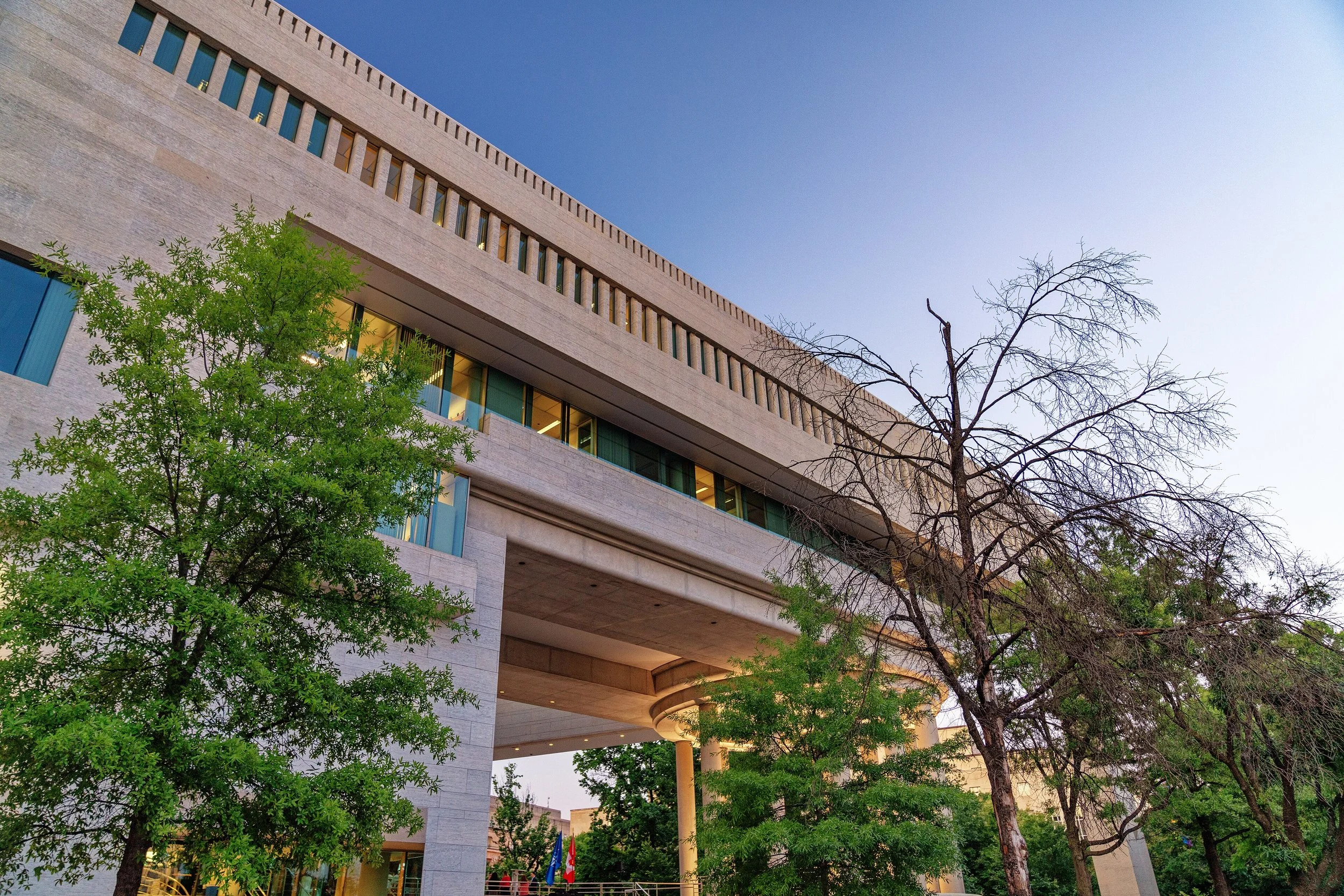
A view of the Embassy of Canada in Washington, D.C. Designed by Arthur Erickson, the project emerged via a highly controversial 1982 design competition, which saw a jury vote personally overturned by then-Prime Minister Pierre Trudeau. PHOTO: Tony Webster via Flickr Commons.
For decades, Canadian public procurement has been an architectural bête noire. In 2026, the broad problems are well-established. Across the country, municipalities, provinces and the federal government alike have long favoured a combination of past experience and low fees, a paradigm that has stifled innovation and kept new ideas from entering the civic conversation. And while the rules ostensibly exist to reduce risk and uncertainty, the status quo accomplishes neither, with Canadian public works — from schools and community centres to entire transit lines — facing chronic delays and cost overruns.
In fact, the system is wound so tight it sometimes ends up tripping over its own rules. This was the case for Global Affairs Canada (GAC), a federal body responsible for diplomatic and consular relations, including the maintenance and construction of Canadian government offices abroad. Below, an anonymously published piece — written by a prominent Canadian architect — outlines a series of recent Requests for Proposals (RFPs) by the agency, including for a project in the Democratic Republic of the Congo (DRC) that was ultimately awarded to an Italian engineering firm.
Despite a requirement for the winner — or, in RFP jargon, the prime consultant — to be a licensed architect, the successful bid was instead submitted by an unlicensed consultant fronting for a foreign firm specializing in engineering. What happened? A much larger GAC project hints at chronic tensions. In Mexico City, an RFP to build a new Canadian embassy required the winner to have already completed a Mexico City project of comparable value, and have design awards from either Canada or Mexico. How many Canadian firms would qualify?
While the emphasis on awards seemingly presents a welcome — and likely well-intentioned — departure from the cost-driven status quo, it ends up recreating a familiar Venn diagram of criteria that narrows the selection to an almost non-existent cohort. Instead of encouraging competition, the system consolidates monopolies. Instead of ensuring fairness, it leads the public sector to bend or break its own overly restrictive rules. And it’s not just GAC. From land use and building codes to procurement policy, Canadian bureaucrats and politicians chronically fail to grapple with the regulatory apparatus that shapes our built environments. Forget the intentions, we ought to start looking at outcomes.
The essay below attempts to do just that. But why publish anonymously? The reasons are simple. In speaking with the architect, the risks quickly became apparent. For any practitioner turned vocal public critic, there’s a good chance that the phone stops ringing — or more acutely, that RFP submissions quietly stop winning. Yet, while the polemic comes from a place of understandable frustration, it’s also rooted in an unfailing optimism that we can do better, and that things can change if we’re willing to stick our necks out in the name of openness and honesty. EXPO shares that belief. — Stefan Novakovic
There are over three hundred Canadian embassies and consulates around the world. Each serves both a practical and a symbolic purpose. A fundamental function of diplomacy is to represent Canada: our culture, people, resources and technology should be on display in foreign nations to show who we are and what we represent. From the humble to the grand, they embody Canada on the world stage while providing essential resources for travelers, businesses and diplomats.
Some of our foreign properties are powerful architectural statements that carry tangible weight in our cultural diplomacy. Raymond Moriyama conceived the Canadian Embassy in Tokyo as a way to “create a symbol of Canada, of spaciousness and diversity that would be meaningful to the people of Japan.” Designed by a Canadian architect of Japanese descent, the building is an embodiment of Canada’s multiculturalism — and an example of soft power. Featured in magazines and newspapers around the world, the embassy became one of Japan’s top destinations upon opening.
Even humble foreign missions serve an important cultural purpose. Like our ambassadors and consuls, they represent Canada to the world. Moreover, they have traditionally offered a global showcase for Canadian architects and designers. Through design and engineering, they are reflections of Canadian talent, technology and competence. More prosaically, hiring Canadian firms has ensured Canadian sovereignty in our design skills and provided an opportunity for Canadian firms to grow, building international expertise. Canadian foreign missions become opportunities to show Canada to the world. To attract investment, to show ourselves in the best possible light and represent our values.
These are simple principles, and ones formalized through Canadian government policies and directives. Federal procurement protocols — which dictate how architects are hired — include measures to achieve best value as well as policies to award procurement contracts that contribute to jobs, innovation and economic growth. Innovation, Science and Economic Development Canada defines “best value” as a broad set of criteria that include “environmental and ethical considerations and socio-economic benefits to Canadians.” The Office of the Procurement Ombudsman, in their May 2025 release, notes that best value historically emphasized monetary value which evolved in 2008 to “acquire goods and services…in a manner that enhances access, competition and fairness and results in best value… to the Crown and the Canadian people.”
These goals are reinforced with more recent federal initiatives to buy Canadian and focus on a strong and confident workforce that builds resilience and economic sovereignty.
As a practicing Canadian architect, my decades-long experience in public sector procurement has been challenging. For most of us, procurement policies and processes are a significant barrier to doing business, frequently erecting barriers to entry for new firms and reinforcing a “fee race to the bottom” approach that undermines fairness and equity. As Ezra Klein and Derek Thompson write in their book, Abundance, “The measure of government is the people it helps, not the processes it follows.” Rarely is the procurement process seen as a benefit to the outcome.
Are procurement processes helping or harming Canadians? Are Canadians being well served by the processes put in place that inhibit firms, limit competition, undermine creativity and otherwise hamper our ability to deliver our services?
Today, designers know that the centennial-era heyday of public competition and risk-taking in civic buildings is increasingly far in the rearview mirror. In the 21st century, Canadian public procurement is based on a complex interplay of technical criteria, risk transfer and, ultimately, low fees.
Yet, a more prosaic — and surprising — reality is a procurement process that can entirely preclude Canadian designers from participating in international projects to begin with. Recent experiences with Global Affairs Canada (GAC) are a case in point.
In November 2023, GAC issued two Invitations to Qualify (ITQ) for physical security upgrades, one in The Hague and one for an unspecified location in Central Africa. In June, the balance of the RFP for The Hague was issued. I was part of a team that lost the bid largely because we mistakenly submitted the 2009 major renovations (designed by architects—Alliance, with Atelier PRO architekten) by our local partner as an example of our team’s relevant project experience. As the cut off for “relevance” was 2014, we received zero points. Its relevance should be a criterion — and not one based solely on what year it was completed. Nonetheless, this was an oversight and we accept that rules are rules, dogmatic and restrictive as they may be.
In August, six months after qualifying, the RFP for the Central African project — revealed to be in the Democratic Republic of the Congo (DRC) — was released. This included an expanded scope of work: a 400-square-metre, two-storey, free-standing addition to the Embassy complex, as well as perimeter security walls, guard huts and other security upgrades. In addition to hiring a local firm to support construction, the bidder had to retain local geotechnical engineers, water quality testing and other deliverables outside the normal services of an architect.
Despite travel advisories on GAC’s own websites, warning of high risks due to crime, civil unrest and violence, bidders were responsible for their own security when traveling to the remote site. All risks associated with retaining a local architect were the bidders to assume; the bidder became contractually responsible for the local firm’s performance, including payments for local services (all of whom insisted on cash payment, up front, in US dollars).
Bidders were forced to accept the risk that they would do business in unsafe and unsecure conditions. GAC accepted no responsibility for any risks bidders might incur while doing work on behalf of the government.
Our proposal was based on fairness and trust in a transparent procurement process and the expectation that, given evolving challenges, we would have a fair and sympathetic client with whom we could manage risks if things became difficult. Fundamental to the RFP was the mandatory requirement that the prime consultant must be an architect with a Certificate of Practice. We expected the rules to be followed.
In December — more than a year since the original invitation was published — it was announced that the winner was a Toronto-based consulting firm with, apparently, no Canadian employees or experience. In fact, the winner is not an architecture firm and has no Certificate of Practice. Their parent company is an Italian engineering firmwith a paper subsidiary in Toronto.Their website, until recently, suggested that they offered engineering services in both Canada and in Italy but their website now appears to make no mention of a Canadian office
In awarding this work, GAC has broken the very procurement rules they established.
Let’s be crystal clear: GAC required that the prime consultant be an architect and chose to award the contract to a firm that is not an architecture practice, has no architecture license and has no Certificate of Practice.
If the rules for currency of work are fixed and immutable, with no tolerance for seeing that 15-year-old work is just as current and valid as 10-year-old work, then the criteria for basic compliance with who is qualified to be the prime consultant ought to be at least as important.
If we uphold dogmatic standards for qualifications, we ought to uphold them universally. An RFP for hiring an architect who in turn subcontracts engineering services in support of an architectural project is both normal and expected. The architect is the prime consultant, hired to be the “one neck to choke” who oversees consultants and the overall design of the project. Hiring an unregistered, unlicensed, non-professional who subcontracts to the required regulated professional is akin to hiring a carpenter (who subcontracts a lawyer) to defend you in court. You haven’t hired a lawyer, have no contract with the lawyer and the carpenter does not have the training, expertise nor credentials to contract with you.
Protests to GAC went unheeded and the procurement was upheld. An appeal for fairness to the Office of the Procurement Ombudsman failed as their threshold for review is contracts less than $133,800, an absurdly low threshold for professional services disputes. An appeal to the Canadian International Trade Tribunal, the only other appeal option, was submitted and a “decline to investigate” decision was rendered without discussion in less than two days. The only other option is an application to the Federal Court of Appeal, an expensive legal process that would needlessly tie up the courts.
GAC’s position is that the parent company is an engineering firm with an in-house architect and therefore meets the requirements of the RFP. But the RFP clearly stated that the prime consultant must be an architect; it made no mention of the acceptability of hiring unregulated, unlicensed, consultants who subcontract the work.
If a rules-based procurement process is to be followed, is this fair?
In a culture in which we look at contracting and subcontracting anomalies — like the federal ArriveCan scandal — is it right that we are contracting in a way that circumvents the intent of the process? If the intent is to hire an architecture firm, should we accept that hiring unregulated and unaccountable parties who subcontract the work is acceptable practice?
The RFP wasn’t limited to Canadian firms. Any architecture business in the world could have responded and won the contract, provided they met the mandatory requirements. While it would have been a good idea for GAC to prioritize Canada in hiring a firm to design a Canadian asset, it wasn’t part of the process.
Lacking that pride in a “made in Canada” solution, GAC decided that an Italian engineering firm can best represent Canada’s interests, subcontracted through a Toronto consultancy that has, since last year, all but vanished from public record. Our culture, technology, and innovation will be showcased by engineers in Italy.
They may be very talented and competent engineers, but is this the right approach for the Canadian government to use on a Canadian property, one that should be a tool to boost Canadian interests, jobs and talent? No disrespect to Italian design sensibilities; the winning firm may well be excellent.
But it isn’t who should have won. This isn’t a subtle nuance of who is and isn’t an architect or what qualifications and experience they might have. The prime consultant, the one on record as having won the project, does not have the legal or contractual ability to deliver the work as they don’t meet the requirements of the RFP and should have been disqualified from the initial invitation.
Imagine showing up to a job interview to become a brain surgeon with no medical degree, no medical license and no experience, but saying that, if hired, you’ll subcontract the work to your cousin who is qualified in another country, under different rules and standards.
What does it say about Canada that we can’t be bothered to hire a Canadian firm when, at the same time, GAC is encouraging engagement with African countries and institutions to “build stronger, expanded and more visible partnerships” across Africa, “a dynamic continent of growing geopolitical and economic importance – a continent with which Canada shares strong people-to-people ties.”
How do we build this relationship if the physical manifestation of our presence is not, at its core, Canadian?
These are not isolated cases.
In November 2024, GAC issued another two-stage RFP for a new Canadian embassy in Ethiopia. The requirements of the RFP stated that the prime consultant must be an architect and licensed to practice in both Canada and Ethiopia (or engage a local partner) and demonstrate experience in delivering three projects, of which one must be delivered internationally. The most points are awarded to projects located in East Africa and that have received national or provincial design awards. How many Canadian architecture firms meet this requirement? The barrier to entry is so absurdly high that, effectively, almost no one can qualify.
In May 2024, a similar two-stage RFP was issued for the Canadian Embassy in Guyana. Bidders were required to submit their fees in US dollars, even though this Canadian project is being paid out by the Canadian government and its offices in Ottawa. That forced bidders to accept the risk of a fluctuating exchange rate. Is that fair to Canadian firms?
Moreso, inherent in the two-stage process is a “correction period” where a bidder’s initial submission can be corrected if there is a minor technical error. This is welcome and allows resubmission to correct a mathematical or other minor oversight. When we were notified that we were disqualified from Phase 1 of the Guyana RFP over a minor technical matter, it took concerted efforts to demand that we be given this correction opportunity which GAC was reluctant to do. In the end, after much argument, we were granted this opportunity but instead of the required time, we were given less than 24 hours and less time than other bidders to respond to the second phase submission. We know that the review of our Phase 2 submission carried with it some bias because we insisted on being treated fairly and being able to submit a correction.
Colleagues who qualified for a Standing Offer with GAC in 2023 were required to comply with contract conditions that included a professional liability insurance deductible of $2,500. Firms opted to comply with this, for the privilege of serving the federal government but at significant cost; this absurdly low deductible cost some firms more than $15,000 a year in premiums for something that has no bearing on insurance coverage for a claim and should strictly be a business decision of the firm: how much the firm is willing pay out of pocket in the way of a deductible is a business decision of the provider and in no way affects the claims coverage in the unlikely event GAC pursues a claim. It is also out of step with other federal departments. Firms who won a spot on the standing offer were forced to pay tens of thousands of dollars for increased premiums over the course of several years simply for the right to hold a spot, with no guarantee that these costs would result in architectural projects that would give them experience.
Fundamentally, since the deductible is paid out of a firm’s pocket in the event of a claim, what difference does it make to GAC if the deductible is $2,500, $10,000 or $20,000? Why does GAC believe that their approach to professional liability insurance needs to be different from other government departments and that they have a right to dictate the business risk a firm is willing to take with a higher deductible?
On another project we declined to pursue, colleagues built a proposal response for a new Canadian Embassy in Mexico. Minimum requirements included that the winning bidder must have completed at least three projects worth more than $40 million, one of which must be in Mexico City. Layering on the design requirements, at least one of the design projects submitted must have received a design award in Mexico or Canada. The Venn diagram of interested and qualified team members is very small.
As I learned from industry colleagues, a design team was assembled and a proposal was submitted. However, GAC has an email limit of 10 megabytes and refuses to use any form of upload platform or secure file submission process that is common in other government processes. The assembled file, representing hundreds of hours of work, tens of thousands of dollars in effort, was rejected because the file size was too large and no outside link could be used.
Again, a Canadian firm is rejected due to archaic, out of date, processes that undermine a fair and modern procurement system.
Regarding our case in the DRC, written requests for intervention, pre-election 2025, submitted to then-Minister of International Development Mélanie Joly, the Deputy Minister and other MPs were ignored. Appeals to supposedly neutral bodies have been exhausted. Tens of thousands of dollars have been spent pursuing RFPs that are supposed to be judged fairly and consistently, in the best interests of Canadians.
In the end, the Canadian government may get a competent result in the DRC. This is not a complex project, nor is it a particularly high-profile Canadian Embassy. Nevertheless, it is an important project and one that could have brought jobs, skills, and exposure to Canadian firms, enhancing the Canadian economy, cultural exchange, and boosting pride in a “made in Canada” solution. Moreover, it would have provided experience that could have been used to grow a Canadian business; future work experience would build on this modest project and create a track record. That door has closed and, given this experience, our interest in applying for future GAC RFPs is slim, knowing that they may be judged unfairly.
It all adds up to more than a failure of regulatory bureaucracy. Canada has lost the ability to celebrate and support our Canadian-ness, to enhance our resources, research, development and technical expertise. Canada seems to have forgotten that design matters, that design is more than ticking boxes. In turn we are impoverished, as a nation, by our lack of design culture.
It is a shame that our politicians talk about supporting small businesses, creating jobs, fairness and the importance of following the rules but, when given the option, they can’t be bothered. It is a shame that Africans wanting to invest in Canada, travel or otherwise seek refuge will do so in an Italian-designed Canadian Embassy. It is a shame that following the rules is so hard. It is a shame that Canadian architecture matters so little.