
Why “Made in Canada” Furniture Can’t Exist Without Intellectual Property
Industrial designer Jake Oliveira reflects on the launch of Ourse, the political economy of furniture manufacture, and the challenge of articulating a contemporary Canadian design language.
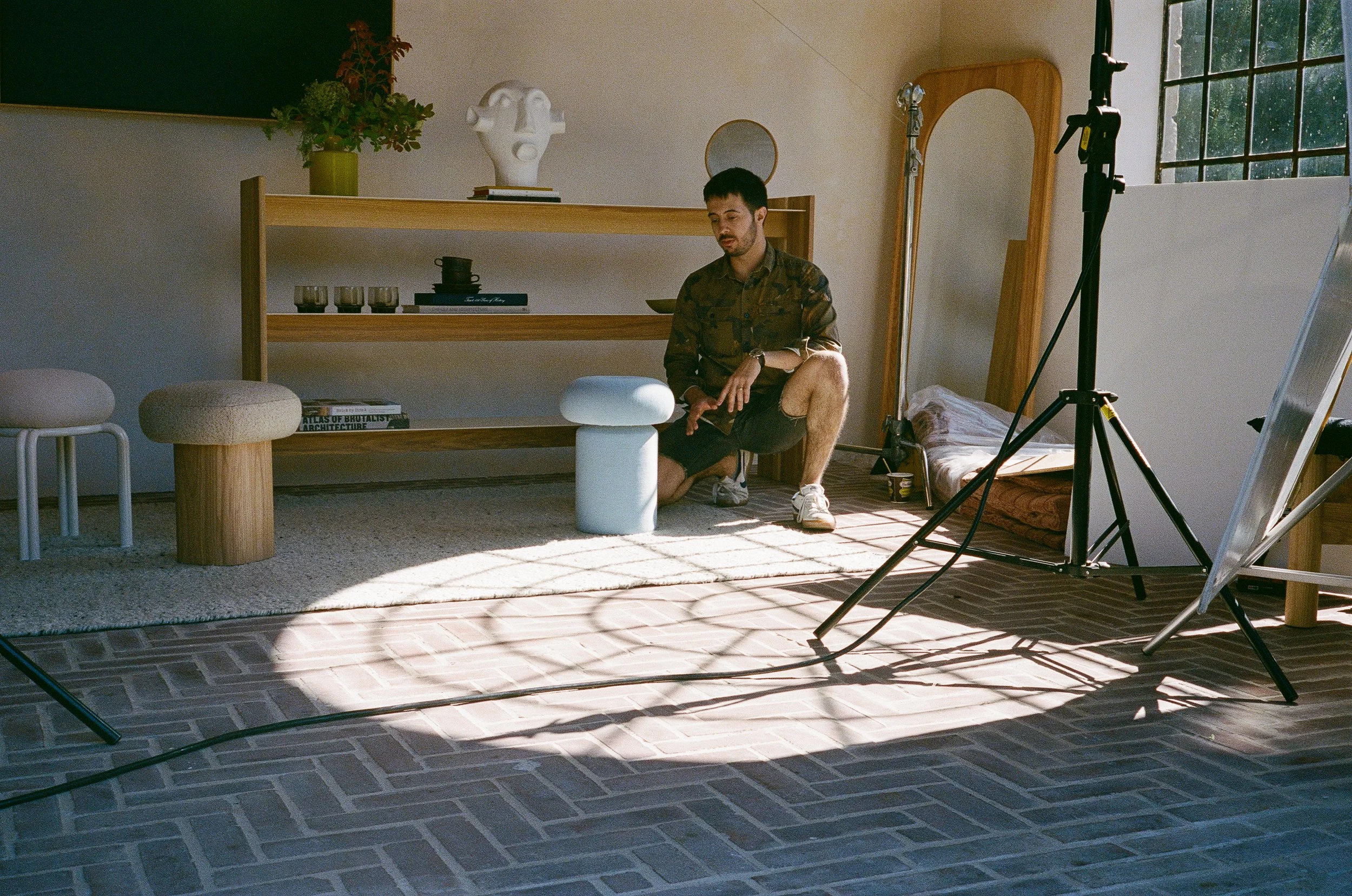
Photo by Carlos Pinto:. Industrial designer Jake Oliveira, Creative Director of Ourse with the Soufflé Stool, designed by smallmediumlarge.
Career paths in architecture are fundamentally straightforward. A fresh graduate can look for work at a firm, teach at a university, or eventually open their own studio. Find a few wealthy clients who want to build houses, and — theoretically, at least — you’re off to the races. The same goes for my own field. As a journalist, you write for student papers, then get an internship and eventually a job at a newspaper or magazine, freelance for a variety of publications, or start your own newsletter and somehow find a way to make money doing it.
Between my architect brother and myself, we’ve tried almost all of the above. Financially speaking, they’ve mostly been bad ideas. Amid an existentially degraded media landscape and an architectural industry where unpaid and underpaid labour are almost universal realities, I hesitate to recommend either field. Still, people keep starting design studios and us writers keep finding ways to eke out a living. Even when it doesn’t work out, we more or less know how to try. But what about industrial design? What does a career path look like?
These questions came to my mind following the recent launch of Ourse, a furniture brand showcasing the work of Canadian designers. Ourse is led by CEO Jason Henderson and Creative Director Jake Oliveira, a pair of young but experienced Canadian creatives. So far, the collection includes pieces by Montreal’s Thom Fougere and smallmediumlarge, Winnipeg’s Nicole Marion and Toronto-based MSDS Studio, as well as a pair of mirrors by Oliveira himself.
Officially debuted at Toronto’s Interior Design Show in January, the versatile brand — with pieces suitable for homes, offices and hospitality settings— emerges at a moment of renewed urgency regarding Canada’s cultural and economic fabric. Riding a wave of growing civic interest in Canadian design and industry, its appeal is obvious. It also begs the question: Why aren’t there more brands like it? I recently caught up with Oliveira to learn more, and talk about what contemporary Canadian design means in 2026.
Congratulations on the launch of Ourse. It’s refreshing — and surprisingly rare — to see designers from across the country showcased in a public-facing Canadian brand. It’s no small feat. I want to start at the very beginning. Where’d you grow up?
I’m originally from a small town in southwestern Ontario, right on the border of Cambridge and the much smaller community of Ayr. My mother was born there — and she came from a big, multi-generational household — and my father immigrated to Canada. My dad worked in a pharmaceutical factory with his brother and my aunt. He eventually worked his way up to being the manager of all shipping, and then becoming a union rep for the employees. On that side of the family, they all worked in the factory because my grandmother had an aneurysm, so they all shifted to work at an early age. And because my dad’s parents didn’t speak any English, the kids quickly started working too.
My mom went to school and became a nurse. Throughout my life, my parents’ work ethic has been a guiding light. On her side, the family was a bit different. Her aunt’s husband was a woodworker; he built pews for a lot of local churches. My grandfather lived in the household, too, and he was an electronics repairman for Sears. So from a very early age, I was surrounded by woodworking tools and electronics, and I became interested in the making of things.
As I got older, it felt like a way of stepping into the arts. I had the sense that making things and working with my hands was something that could lead to a career that I was comfortable with. With the upbringing I had, I think that saying “I want to be an artist” would have felt like a step too far.
I know the feeling. To be honest with you, I feel similarly about “design” as a field. Although I’ve worked for a lot of design magazines, my beat was always primarily architecture and urbanism. To this day, I don’t know what’s happening at Salone del Mobile. Even from a slight distance, the culture of design — of furniture fairs in Milan and Miami, new trend cycles and conceptual exhibitions — feels abstract in a similar way to how high fashion and runway shows seem removed from what people actually wear. You grew up far outside Toronto, much less Milan. How did you get into the field?
Growing up in Cambridge, the only context that I really had for the arts as a career option was graphic design. It was, and still is, a career that felt attainable and viable. I knew that I wanted to have something to do with the Creative Arts, so I started to look into graphic design programs. I was really lucky to have a great teacher, Mr. Greg Cinti. He was a big champion of building things, and he actually petitioned the school to buy a very early 3D printer — back when they still cost thousands of dollars. He showed me that there was a realm in which my arts interest could intersect with the built world, in a way that went beyond just working in the trades. It changed my life. We still exchange emails.
I started looking into different programs. While graphic design still felt like the safest starting point, the program that spoke the most to me at the time was the York-Sheridan design program (YSDN), which was very broad in scope. You’d do everything from typographic history to environmental design, 3D design, web design. It was really an immersive brief into the design thinking of that era, like IDEO documentaries and human-centred design. But it was a really cool education, because it felt grounded in the real world. We had a theoretical foundation at York University, and then did a lot of hands-on work at Sheridan College.
When I got into the program, I quickly learned that I did not have the chops to be a graphic designer. But I took an environmental design class, and my professor Angela Iarocci taught me about Rhinoceros and 3D modelling, and I was immediately hooked. It still seemed like a mountain to climb, but I realized that’s what I wanted to do.
I might be wrong, but it strikes me as a less linear career path than architecture or interior design, where there’s a focused — and pretty narrow — procession from school to practice. You go to an architecture program and it prepares you to work for an architecture firm. What does a career in industrial design look like?
It’s an exercise in risk assessment. I think the safest thing you can do is get a job at a company that hires industrial designers and collect a salary. Like many fields, it hasn't really kept pace with inflation. You can make about $70,000 a year, but the income tends to stay around there. When it comes to opening a personal practice, there are a couple of ways to do it.
One is to self-produce, which a lot of people in Canada try to do. It’s incredibly risky to do, since you’re usually self-financing the design, development and then the manufacture of whatever you want to sell. On top of that, you also have to find who your client base is, and find a way to sell it to them. When you add in student debt and the cost of living, it’s really hard to do — unless you’re independently wealthy or you find an investor.
Having said that, it’s still definitely possible to succeed, especially given that Canada’s domestic market isn’t particularly saturated or developed. A company like A-N-D Light is a good example. They’ve done a great job of building out a portfolio and a client base. If you’re not going to self-produce, the other path to building a business is licensing your designs, which is itself really complicated.
I want to learn more about licensing, but I’m also curious about how you navigated the industry personally. Before Ourse, you opened your own studio in 2021. What did your career look like after graduating?
I had three jobs while I was still in school. I was working at Lowe’s, both in the lumber yard and the garden centre. I preferred the garden centre. I was also working the night shift at the university’s fabrication studio, helping students run laser cutters, press vinyls, and work the printing press. My first real internship was at Umbra in Scarborough. I wanted to be in industrial design, but they put me in marketing. It was interesting in its own way, because Umbra was doing a great job of bringing narrative and storytelling into design.
After graduating, I started working for a Toronto interior design studio that was interested in industrial design. I was working with interior designers who wanted to branch out and design wallpapers, rugs and custom lighting. I got a handful of industry certifications in advanced part modelling, and really honed my technical skills, understanding how manufacturing works, how products are engineered and fabricated. Then I went to Powell & Bonell, another interior design firm, but one where a big part of their business is a furnishings line.
I had a different skillset than an interior designer. I was able to help guide the technical side of manufacturing, as well as the process of growing the business through licensing. It was a great experience. Then COVID happened. Like a lot of us, I got furloughed. Even through that, Powell & Bonell treated me really well — they left the door open to me to design for them in the future. So I tried to see it as an opportunity. I’d always wanted to run a personal practice.
I love designing, and I very much enjoy the engineering aspect of it — I’m literally drawing things at 1/4 scale, as opposed to sketching them and then passing it off to someone else. So I thought of myself as “hands-for-hire,” where I could work with architects and interior studios to help them realize industrial design projects. For example, I worked with Fox Whyte Landscape Architecture, helping them develop a line of outdoor planters. So my studio was founded with a consulting arm as one part of the business. More fundamentally, though, I really wanted to build a design portfolio, and I was able to start licensing my work for Powell + Bonell, as well as companies like A. Rudin and Boyd Lighting.
I’ve been hesitating to do it, but now I’m going to ask an embarrassingly naive question. What is licensing and how does it work?
I’m actually glad you asked. It’s something that isn’t really explained to us either in school, and I often find myself explaining the process to younger designers. It’s good practice. At its simplest level, a designer develops a product — whether it’s a sofa or a piece of lighting — and then they present it to a brand that fabricates, markets and sells it. The brand invests the overhead on materials and manufacturing, while the designer retains a credit and some portion of the profit.
In a sense, it’s kind of like Intellectual Property in music. A record label might put out an album, but the singer and the songwriter are recognized and they receive a royalty. Like in music, the intellectual property rights might even revert back to the designer after a certain number of years, depending on how the IP is negotiated. In design, there tend to be some gray areas around this, which I’ve learned from IP lawyers. For example, if the final CAD drawings are produced by the brand, that IP may not ultimately belong to the designer.
I’ve often wondered about this stuff. In a place like Design Within Reach, all of the products have little tags that tell you who designed them and what inspired them. IKEA has it too. Why isn’t this more common? If I go to a place like Structube or West Elm — or a newer direct-to-consumer Canadian furniture brand like Article, Cozey or Sundays — it would be cool to learn about who actually designed this stuff; to put a face, a name, a story to it.
That’s licensing. So when you see those little tags at IKEA, for example, it’s because IKEA has started licensing designs for some of their products. With IKEA, I think they were smart to realize that the designer is a marketing asset, and that telling those stories that you see on the label can help build public interest around the product. As to why it isn’t more common, I can’t speak to the specifics of why any individual brand doesn’t do it.
Looking at the industry as a whole, however, I do have a couple of theories. Licensing had a real heyday in the 1980s, when the narratives around design were really fundamental to brand identity for a lot of furniture companies. That faded as companies started to compete more and more on price. It’s a shift that I think was aided by the expansion of international shipping, modular assembly and overseas manufacturing, as well as the rise of online retail — which allows companies to save money on brick-and-mortar real estate. Working with an in-house design studio helps streamline things further.
It means that designs can be fine-tuned to optimize fabrication and shipping costs, without worrying about the designer and their IP. As designers, we can be really sensitive about this stuff! So by removing the layer of licensing, brands can also insulate themselves from a designer complaining about how their work was compromised, or filing legal claims for IPs and royalties. Ultimately, it’s another way of saving money, which is understandable. I don’t necessarily want to denigrate that business model, but it’s very different from what we’re trying to do with Ourse.
It’s a really interesting way to look at it. To my mind, it’s fairly obvious that as consumers we have to pay extra for things like natural materials and Canadian manufacturing — even though we’re hesitant to do so. We should think about intellectual property in the same way. If we want to support Canadian creativity, we have to be willing to pay a little bit more to support licensing just like we pay more for real wood and ethical labour.
These types of conversations were Ourse. In the same way that you worry about opportunities for journalists and architects, one of my motivations is to open career pathways for designers. I didn’t want to be telling budding industrial designers to all move to Denmark. I think there’s something sad about having to jump ship — it makes me think about how we effectively abandoned the Canadian aviation industry when the government cancelled the Avro Arrow.
It started small. Jason and I met for coffee. Jason has a lot of expertise in bringing European brands to the Canadian market, and he understands that there’s a deep interest in what’s being designed and made in Canada. Maybe there isn’t quite as much demand for it as we’d like, but we know it’s there. So we started talking: Can we create opportunities for designers to do work for a Canadian brand? And to do that, can we find a different story to tell, one that doesn’t just hinge on “how much does the chair cost?”
What does that conversation look like? I can’t think of many Canadian design brands that celebrate local design and manufacturing — outside of a very premium or collectible context. We have well-respected office furniture brands like Keilhauer, Nienkamper and Teknion, but they have little visibility to the general public. Even for someone like me, buying a “designer” couch feels totally out of reach.
We definitely get some comments like that from the public, people are shocked at how much it costs. We’re not working at a luxury price point, but the reality is that there’s just no way to make a solid wood chair for $500 in Canada. With material costs, and paying people a living wage, it’s just not going to happen. But to a lot of us, paying $800 or $900 for a chair seems crazy, right? Especially if we can buy a chair for $150. We looked at brands in Scandinavia, many of which have been around for well over a century, and the way that they celebrate that heritage but also stay relevant by creating opportunities for young and emerging designers. So why can’t we do that here?
I think it changes if we can reconsider our pace of consumption. In North America, we’re constantly buying things and constantly getting rid of them. It means we furnish our homes in the same way that we buy consumer electronics. How many people get a new phone every single year? Whether it’s a Playstation or a smart home camera, these market segments have figured out a way to profit from a disposable culture where everything gets thrown away and replaced. Furniture follows the same pattern.
People scoff at a high price tag for a kitchen table, but what is it really worth if you have it for 30 years? Someone had to build it, but they earned a living wage. And it lasts for decades. And then you think of all of the family memories that happened around that table over the years. As a design community, I think these are stories we have to tell.
I think you’re doing a good job of starting to tell them. Where comes next for Ourse?
We’re just at the very beginning. So far, I’m proud of the fact that 60% of the designers we’re working with are women, which is still a relative rarity in what remains a male-dominated field.
But we also want to cultivate more diverse perspectives. We’re not yet working with designers from the north, or from either coast. And we also want to create opportunities to work with Indigenous industrial designers, and I’m really excited to now be having those conversations. And I think that really interesting things are happening as we move away from the metropolises.
What does great industrial design look like in Prairies, for example? I don’t think of myself as a taste maker or a trend-setter — I want to be educated by it. To learn from the designers that are working there and help them develop their work and bring it to market, and to help create an ecosystem where designers that come out of school can do great work in Canada.
And we have to expand our cultural understanding of design. It has to go beyond “How much does this mirror cost? How much does this chair cost?” It’s not about imposing a particular sense of taste. I think that great design emerges from our culture, and it speaks to our lives and something we’ve experienced. Maybe it’s a sense of deja vu — a piece of furniture that reminds us of our high school cafeteria, even though it looks very different.
It’s not for me to dictate what that is. We tell designers that we want inspiration to come from them, not the brief we give them. What we can do is help excavate what that inspiration is, help them find it and bring it out into the world. Ultimately, my goal is to stand on a soapbox and really speak proudly about the brand and these designers. I want to be able to say “This is Canadian design. This matters.”